Zetamotion Featured in Industry 4.0 Today: Why Data Loops, Data Moats, and Deployment Control Matter in Industrial AI
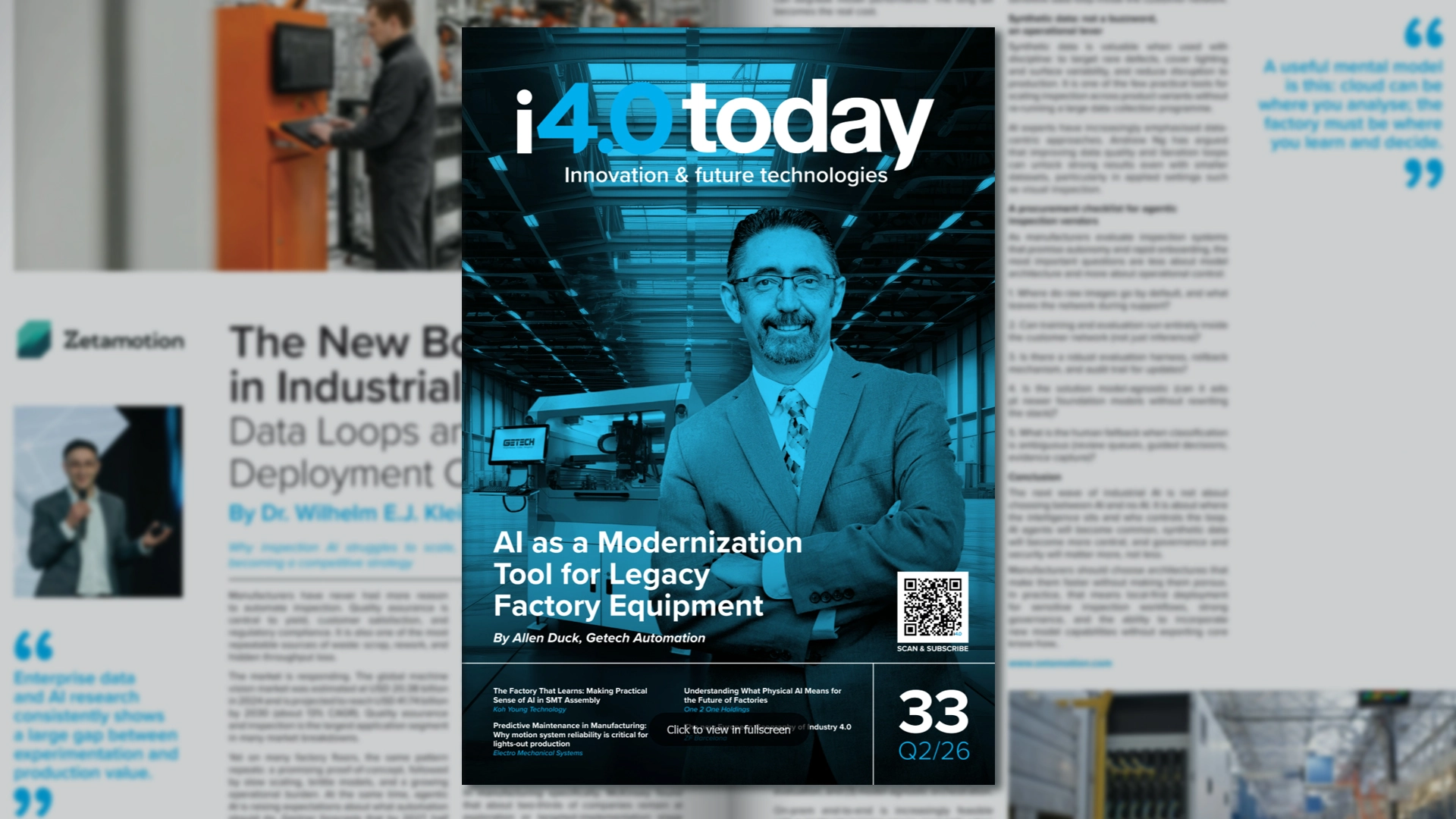
We’re proud to share that Zetamotion has been featured in Industry 4.0 Today with an article by our CEO, Dr. Wilhelm E.J. Klein, titled “The New Bottleneck in Industrial AI: Data Loops and Deployment Control”. Flip through to page 19.
The feature makes a simple but important point: in industrial AI, the next bottleneck is not model quality alone. The harder challenge is making AI systems work reliably in real production environments, where product variation, process shifts, rare defects, security requirements, and operational pressure all show up at once.
That gap between pilot success and production value is where many projects stall. A model can look strong in a controlled proof of concept and still struggle once it meets changing lighting conditions, new SKUs, surface variation, factory workflows, and the need for repeatable day-to-day operation. In that sense, industrial AI is not just a model problem. It is a systems problem.
This is why data loops matter so much. What ultimately makes an inspection system useful is not a one-off training run, but the ability to capture new data, review edge cases, improve the model, and redeploy safely over time. In manufacturing, strong feedback loops are what turn AI from an experiment into an operational tool.
That is also where the idea of a data moat becomes important. In industrial settings, the real long-term advantage often does not come from the model alone. It comes from the proprietary production data, inspection feedback, defect history, and process knowledge a manufacturer builds over time. The stronger and more controlled those data loops become, the more defensible the system becomes. In that sense, a data moat is not a marketing slogan. It is the accumulated operational intelligence that makes inspection systems more effective, harder to replicate, and more valuable over time.
The article also argues that deployment control is becoming a strategic issue. One of the clearest lines in the feature is: “Cloud can be where you analyse; the factory must be where you learn and decide.” For manufacturers, that matters because inspection data can reveal process knowledge, supplier differences, defect behaviour, and production know-how. This is where data sovereignty matters too. Manufacturers increasingly need clear control over where their data goes, who can access it, how it is used, and whether critical learning stays inside their own operational environment.
This is also why governance matters. Auditability, rollback, human fallback, and clear control over data and model workflows are not administrative extras. They are part of what makes industrial AI usable at scale. If manufacturers do not retain sovereignty over inspection data and deployment decisions, they risk weakening the very advantage their systems are supposed to create.
The article briefly highlights synthetic data in that same practical light. Not as hype, but as an operational lever for covering rare defects, difficult variation, and scenarios that would otherwise take too long to collect from production alone. Used properly, it can help reduce bottlenecks in validation and adaptation.
This perspective is closely aligned with how we think at Zetamotion. Manufacturers do not need more AI theatre. They need inspection systems that are deployable, controllable, secure, and able to keep improving in the real conditions of factory life, while preserving ownership of the data advantage they are creating.
We’re grateful to Industry 4.0 Today for featuring Zetamotion and this perspective.